This week, the government published it’s Creative Industry Strategy - a long document which outlines the ambitions and interventions the government will take in order to support the creative industry, one of the pillars of it’s growth strategy for the UK.
Whilst the full strategy is worth a read, something which many have already reported upon and picked up is the recognition of how important freelancers are to this industry. I thought I’d pull out a few bits from the strategy which might be of relevance to you as a freelancer.

A key role in the sector’s dynamism. Estimates put freelancers at around 60% of the workers in the creative sector. That’s not just a key role, that is the vast majority of people in the creative industry. There is no creative sector without self-employment, micro and small businesses.

Resilient. Skilled. Diverse. These are all essential, and massively underdelivered at the moment within the sector. We know from research from bodies like The Film & TV charity or the work which Leapers does that mental health is a significant challenge, and a multiplier effect is in place when self-employed. We know across many sectors in employment, training and development is underinvested, and in self-employment, access to affordable training and development is even harder. And diversity - again poor in employment, but even more shocking levels of discrimination in self-employment. So all key points which need addressing.
(Of course, resilience isn’t really the issue here - it’s changing the environment in which we work, so we don’t need to be resilient. If hirer behaviours improve, we can worry less about resilience training, and more on doing brilliant work.)
Specifically calling out freelancers here is brilliant - as it gives us something to hold government to account on.
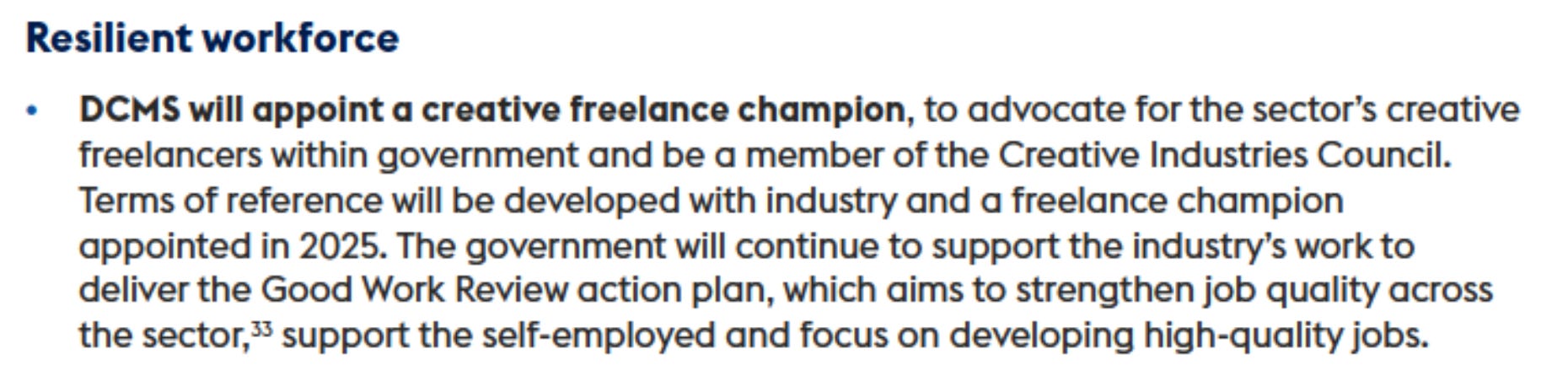
The appointment of a “Creative Freelance Champion” has been called for many years from bodies like Creative UK and Bectu, as well as many community bodies and activists. Terms of reference will be developed with industry - which I hope of course includes consultation with us, the freelancers, not just employers, and supporting the self-employed in context of the Good Work Review is again another positive.
This is a hugely welcomed and exciting move - who it will be, how they will work with all of us, and represent the diverse voices and ways of working in the industry is yet to be seen, and how much influence they have over policy, we shall see - but this is a massive step forward in being directly represented in government.

Again, more engagement with individuals, bodies, communities and companies - very much welcomed.
Honestly, I’m really excited, pleased and keen to learn more about how the role will be defined, how they go about engaging with us, and what positive impact it might have on the industry at large.
But what should a Freelancer Champion be considering? Beyond the immense task of listening to the broad set of voices, what are their priority and focus likely to be?
Here’s my view on the most pressing challenges our industry might be facing, through the lens of a freelancer and working with freelancers.
1/ Contracts and Payments
Too many freelancers work without fair contracts and get paid unfairly or late. Requiring clear and fair contracts should be law, and stricter penalties for late payers to sole, small and microbusinesses is essential. Late payment is a massive issue, but the most common snagging point around late-payments is lack of clarity around contractual terms, so these need to be dealt with, hand in hand.
2/ Complexity of status, rights and taxation
IR35 naturally will be high on people’s agendas for change, but I don’t expect it to be an area of focus. However, simplification and alignment around taxation and rights when it comes to worker status is essential. Whether the freelance champion is in the right position to push for this, we shall see, but the complexity and lack of clarity around this is massive, for both hirers and freelancers.
3/ Discrimination, bullying, harassment.
Stronger guardrails, clear paths for escalation, arbitration and better signposting and support for freelancers encountering major issues when working with hirers. There is rarely any route for complaint, or right to reply. An independent body (perhaps the OSBC) to deal with issues, and investment in to resources and support lines (via charities or similar) needs to be in place. And dealing with the organisations who are repeat offenders, to hold them more to account.
4/ Mental health
Better signposting to good quality resources, support and infrastructure for mental health of the self-employed. Investment in to developing services which are made available to those registered as self-employed, tax-breaks on accessing therapy or healthcare for small businesses.
5/ Pricing and Cartels
More action taking against businesses who collude to drive down pricing and day rates for the self-employed, and tax breaks for businesses who invest in SME suppliers over larger businesses.
6/ Pensions, Insurance, Mortgages, Sick Pay, Parental Leave and Holiday Pay
Tax breaks and incentives for self-employed individuals to be able to invest in pensions, insurance, mortgages, and optional schemes to support sick pay and parental leave pay for freelancers. Equal rights to SSP and Parental Leave for the self-employed. Enforce hirers to pay pension contributions and holiday pay if freelancers deemed to be workers or on PAYE and via umbrellas, rather than no-rights-employment. Allow hirers to pay benefits and contributions to rest, wellbeing and learning and development, without being at risk as seen as an employee.
7/ Accessible access to education and training
Investment in affordable and accessible training for those new to self-employment and those established in self-employment, to develop new skills. Allow training in new disciplines to be tax-deductible.
8/ Clear accountability within hirers for freelancers
In the same way we have a DPO role in most businesses, a named individual who is responsible for the rights and fair treatment of freelancers within a business, who is responsible for reporting on working practises, diversity, day rates, payment timing, etc. And published reporting for larger businesses, or those who hire over 50 freelancers in a year.
I’d also make ghosting illegal, but that’s probably harder to enforce.
There’s so much more that we could be looking at though - what are the most pressing issues you’d want a freelance champion to be tackling?
I’m going to be working with a number of the freelance communities over the coming weeks to try and create a ‘coalition of communities’ so it’s a little easier for government to listen to more of us, as I recognise it’s going to be such a huge challenge, listening to the 2m odd freelancers in the UK, in a consistent fashion.
If you’re a community leader, drop me note.
If you’re working with freelancers and want to know what you can do to help, drop me a note.
Anything we can do collectively, as freelancers and those who work with freelancers, to help each other be heard, the time is now.